
OPENRBT — vending-machine software
DevelopedCash sales continue when the internet goes down
Local Linux software connected payments, the dispensing controller, stock levels and day-to-day vending-machine operations.
Discuss a similar project
Original project materials
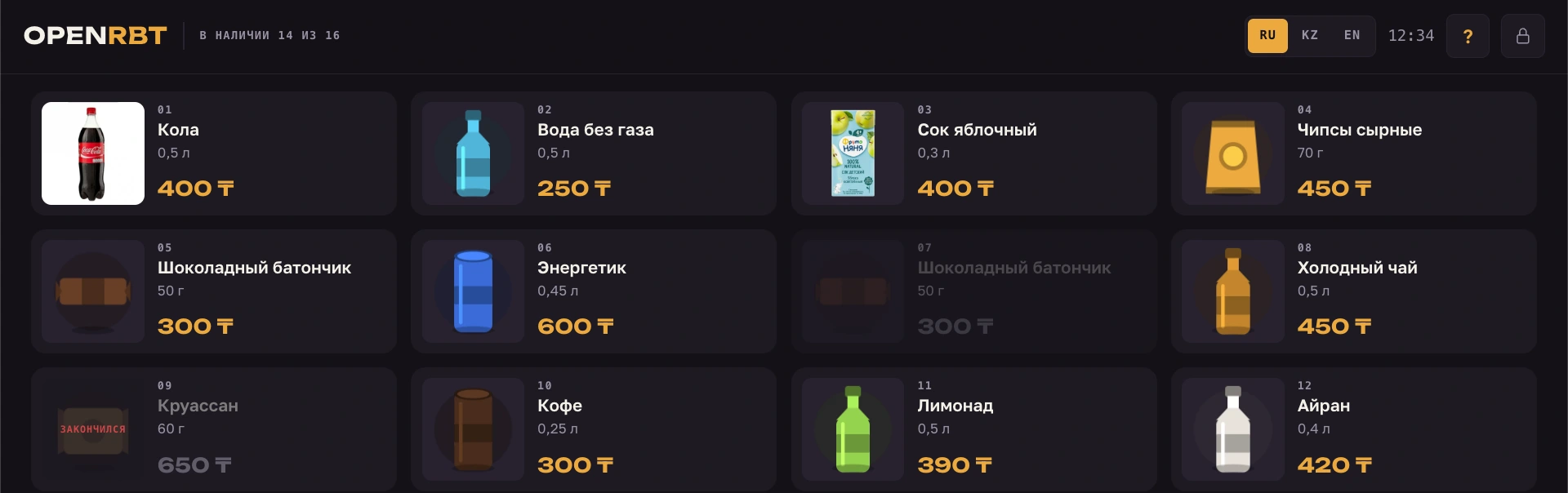
A buyer-interface excerpt from development materials, August 2026. Product cards show price, slot and availability. This is an archived screen, not operating-performance data.
In this article
Hardware needs to work as one point of sale
OPENRBT already had controllers, cash acceptance hardware and its own Kaspi payment service. It needed software to connect these components to a clear product-selection interface and the operator's daily work.
Behind the purchase button is a sequence of events: money is accepted, the correct mechanism is selected, the command is executed and stock is updated. There is no cashier nearby to correct an error manually. Sailet therefore worked through successful purchases, insufficient payment, connectivity loss and hardware failures.
Dispensing is linked to stock updates
The local Linux application starts dispensing after payment is confirmed. It reduces stock after a successful controller response. If the mechanism returns an error, the application displays the problem and retains the transaction details.
Cash is processed on the device and remains available without an internet connection. Kaspi QR requires connectivity to the client's payment service. Sailet connected that service through RabbitMQ; OPENRBT's controllers and firmware continued to perform their own part of the process.
The product logic reflects the limits of hardware confirmation: the controller confirms movement of the mechanism, but the machine has no separate sensor to detect a product dropping. If a package gets stuck, the buyer needs the operator's contact details and the operator needs the transaction history.
The on-site operator manages the assortment
The operator workspace mirrors the grid of 16 slots. Operators assign products, upload photos, change prices, replenish stock and disable items.
A product is separate from its slot. If the same drink is stocked in several positions, its price is changed once while quantities remain separate for each position. Reports and exports help investigate sales, stock changes and dispensing errors.
The client received the completed software
The project was completed and handed over to OPENRBT. The buyer interface, sales logic, hardware integrations and operator workspace run in one application. An archived screen and the director's review of the collaboration are available.
The practical result is that cash sales do not depend on a cloud connection, while equipment actions are linked to stock records and maintenance. Sixteen slots describe the machine's configuration, not the number of devices deployed. This version does not provide automatic refunds or give change; the payment flow explains these limits to the buyer.

