
InBuh / Internet Accounting
DevelopedService delivery connected to payment and the team's work
An accounting provider's customer platform: companies, plans, billing, support requests and server infrastructure for cloud-hosted 1C.
Discuss a similar project
Original project materials
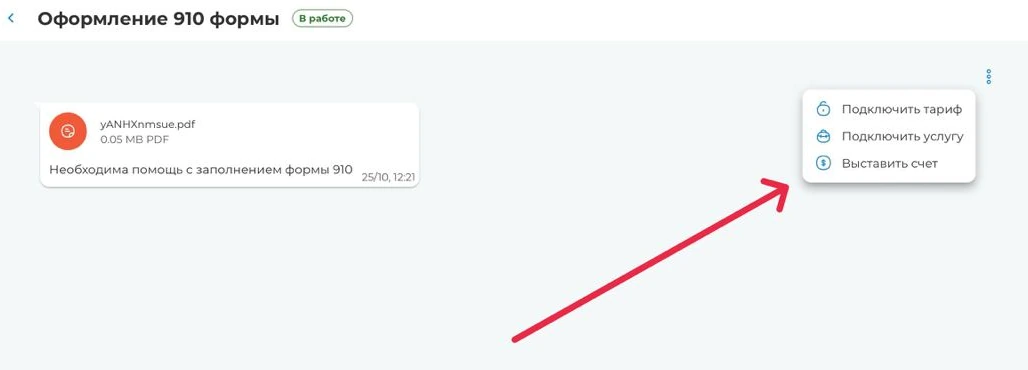
An employee-workspace excerpt: a plan or service can be activated, or an invoice issued, from a request. The arrow was already present in the original manual. This is a demonstration request, not a measure of actual transaction volume.
In this article
Two service lines needed a common foundation
Internet Accounting offered cloud-hosted 1C and outsourced accounting. A customer needed to be onboarded, assigned services, invoiced, supplied with documents and supported. The cloud service also involved databases, users and access permissions.
Sailet developed a platform for these relationships. A user can manage several companies, each with its own services, plans, balance, invoices and operational requests.
Billing is part of service delivery
In the portal, customers select a service or plan. Its parameters are connected to the company and its payment position. Recurring service supports next-month invoicing, reminders and service restrictions for non-payment. A service-completion document becomes available after payment.
Payment channels work differently. Card payments use a bank-hosted form. For transfers, a manager confirms receipt of the funds. Kaspi QR is also checked manually in the version described here; this is not automatic confirmation through an API.
This model separates the provider's billing for its own services from the accounting and tax records of its customers' companies.
A request can lead directly to fulfilment
Customers attach documents and communicate with an employee in a support request. From that record, the employee can activate a service, change a plan or issue a one-off invoice. The request context does not need to be copied into another section.
WhatsApp enquiries are connected to the technical team and associated with the relevant company when the phone number matches. Documents, notifications and history support the service process.
The server work included provisioning 1C databases, accounts, Active Directory groups and RDP settings. This infrastructure covered several servers and went well beyond the web portal.
A completed phase with a defined boundary
The manual and register of implemented modules substantiate customer companies, services, billing, requests and the server component. A later register, however, notes that customer access to 1C had not yet been exposed in the user interface. A completed end-to-end login journey is therefore not claimed.
The engagement has ended. This case explains the development phase and its practical value: the order, payment and delivery team's actions use shared data. Current operation, customer growth, savings and the full original concept are not substantiated by the available materials.

