WWF — Earth Hour 2021/2022
Historical projectA mass-participation campaign that turns interest into contacts
Prepared Earth Hour for peak traffic. In the 2021 campaign, WWF collected 70,000 contacts—50% more than the previous year.
Discuss a similar project
Original project materials
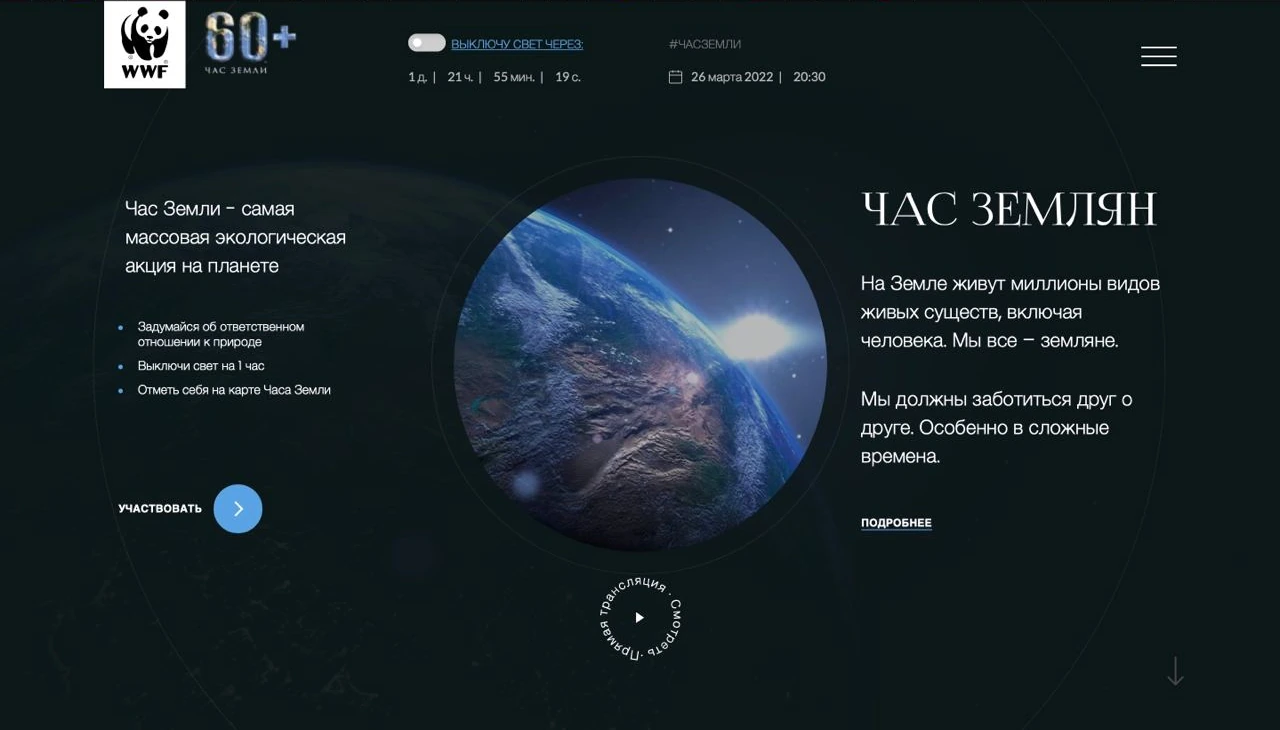
The 2022 campaign site from the project archive. The opening screen shows the campaign title “Hour of Earthlings”, the date 26 March 2022, a participation button and access to the broadcast. This is the new version’s interface, not an illustration of the 2021 results.
Contact figures come from WWF's head of digital in a Clutch review. The 410,000+ visitor figure comes from Sailet's technical retrospective. All figures refer to 2021.
In this article
On campaign day, visitors cannot be asked to return tomorrow
For WWF, the digital part of Earth Hour needed to do more than explain an environmental initiative. Visitors needed to join, mark their city, take a quiz and receive confirmation of participation. The foundation needed to retain contacts and transfer them to its main system.
In 2021, Sailet worked with an existing platform combining Bitrix, a Kohana API, RabbitMQ and map and content scripts. Documentation was limited, and the previous version had experienced problems with the map and data synchronisation.
Connecting the interface to the work behind the form
The team investigated the system, moved it to new servers and built a responsive React interface. Participation forms were connected to the website database, WWF's system and the required emails.
Visitors could choose a clear way to take part: switch off the lights, add themselves to the map or complete an environmental quiz. Registrations updated the counter; cities appeared on the map; the relevant email delivered a certificate or quiz result. The foundation could export and reconcile the data.
Preparing for the peak and the next phase
The user interface, reserve infrastructure with the API, and administration panel were hosted separately. Extra capacity was arranged for the peak period. According to Sailet's technical retrospective, the site received more than 81,000 unique visitors on the day of the event and operated without interruption.
Work continued in 2022 with a different scope: the website was rebuilt in React and Laravel, the main participation options were retained, and the map and counter were reworked. This was a separate version with its own load requirements; its figures are not combined with the previous year's results.
A campaign result confirmed by the client
In a Clutch review, WWF's head of digital reported 70,000 contacts collected, up 50% on the previous year. Sailet's technical retrospective records more than 410,000 visitors across the 2021 campaign.
WWF was responsible for content and promotion. Sailet provided the technical path from initial interest to completed participation and a contact record in the foundation's system. That connection made the visit useful beyond a page view. Final analytics for the 2022 campaign were not present in the materials reviewed, so all reported figures refer to 2021 only.